
What's Kutani
- takaragura
- 2019年2月25日
- 読了時間: 2分

九谷 (Kutani)
The beginnings of Kutaniyaki are enchanted by mystery.
It is said that Goto Gifujiro who studied Arita color painting porcelain firing at the beginning of the Edo period started building a kiln.
What is baked in this kiln is called Kogutani, but it is said that Kokutani was baked in Arita though.
This kiln has been decommissioned in decades and rebuilt by clan in the late Edo period.
It is said that Kutani is reviving for Kokutani what was burned after the rebirth.
Today there are about 600 kilns, which are produced in various ways from traditional color picture porcelain to free expression.
District located in the upper reaches of the Daishoji River in the southern part of Ishikawa Prefecture, western part of the Kaoshi Mountains. It belongs to Kaga city. It was reported as the birthplace of Kutaniyaki, there are kiln marks, and it is designated as a national historic site as Kutani porcelain kiln kiln.
With good quality pottery found at Kutani village of the Daisho Clan territory (now Kaga city, Ishikawa prefecture), let the gods gentry Gijiro go to Arita to acquire skills, and the lunar calendar after the return clan Early (around 1655), although it can be started as a female reproductive policy, after about 50 years (around the early 18 th century) suddenly it becomes a waste kiln. Kiln marks are located in Kagaya Yamanaka Onsen Kutanomachi, and there are two consecutive kilns called the No. 1 kiln, No. 2 kiln and traces of the Yoshidaya kiln revived in the 19th century.
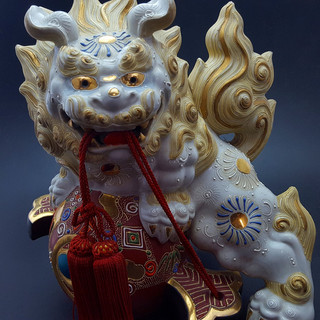
In the Meiji Era, Kutaniyaki became a major export item, and it was exhibited at the Expo such as the Vienna World Exposition in 1873, and at the same time Western techniques came in. Since around 1872 the embossing technique was also incorporated into Kutani ware, the production of figurines including lions became popular since about 1892, and in the Taisho era the mold became made from plaster and mass production advanced.
In 1872 (Meiji 5), the pottery made by the Kanazawa Ward Kaigan Temple was born in 1872 as the institution of the unemployed samurai due to the Meiji Restoration, and achieved results with the participation of Yoshihira Sako, Suzan Suzan, the first generation, etc. In 1876 (Meiji 9), renamed the Ishikawa Prefectural Industrial Park. In 1887 (Meiji 20) Kanazawa Industrial School (current Ishikawa prefectural high school) opened, next generation ceramic artists began to be cultivated.


コメント